
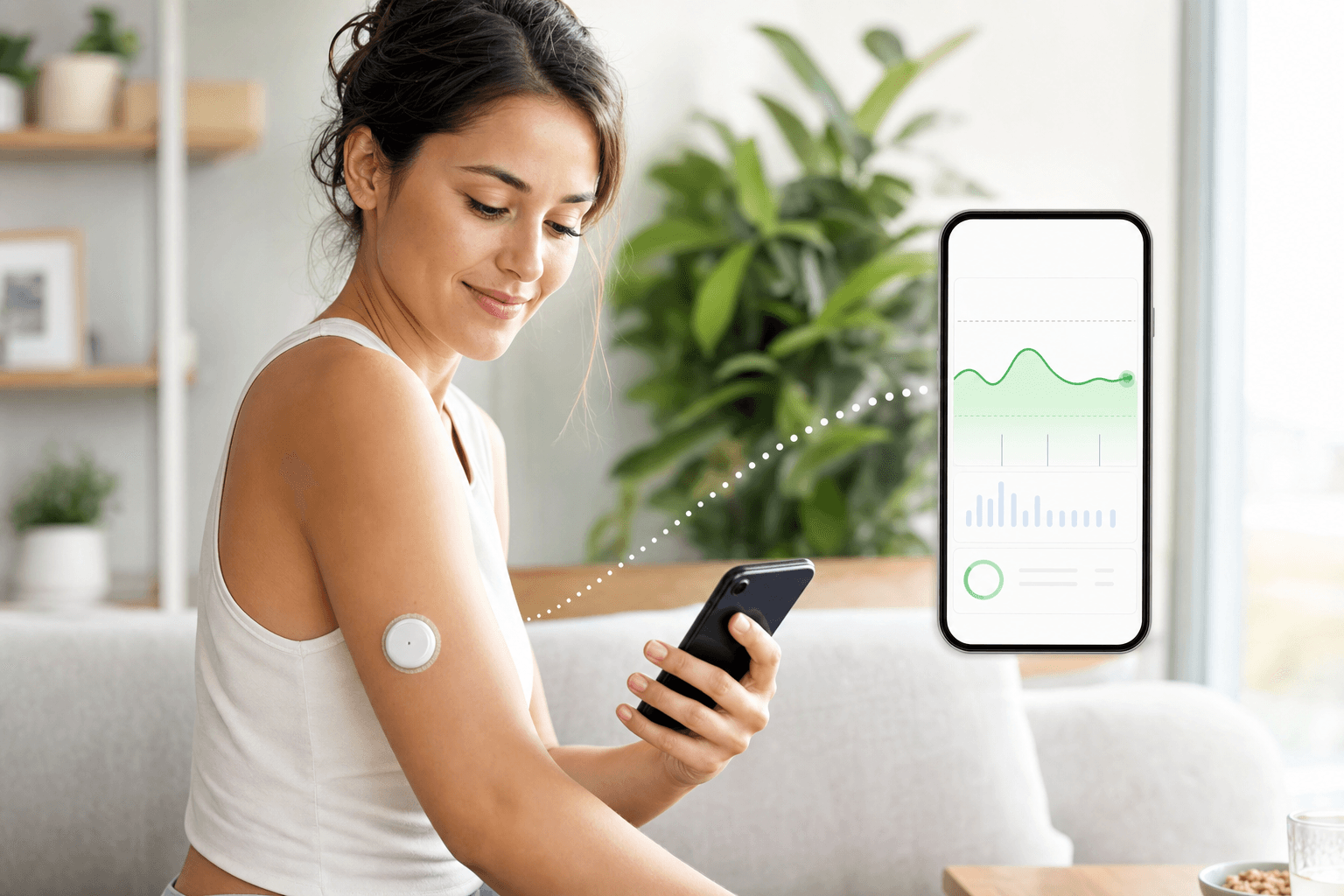
From the arm to your phone
The SIBIONICS GS1 can feel almost magical the first time you use it. You apply a small sensor to your arm, and minutes later your glucose appears on your phone and keeps updating on its own. There is no magic involved, though. There is a thoughtful piece of engineering doing steady work in the background. This article walks through how it all fits together, in plain language. It is educational rather than medical advice, so use it to understand the technology and then speak with your doctor or diabetes team about how it applies to you.
The sensor on your upper arm
Everything starts with a small, discreet sensor worn on the upper arm. Beneath the part you can see sits a very fine, flexible filament that rests just under the skin. This is the part that does the measuring. The sensor is held securely with an adhesive so it stays put through daily life, including showers and swimming.
Applying it is designed to be quick and comfortable. The GS1 uses an easy dual-spring applicator built for a faster and less painful insertion. You position the applicator, press, and the sensor is placed in a moment.
Measuring glucose continuously
Reading the fluid around your cells
A common question is how a sensor on the surface of the arm can know what is happening with your glucose. The answer is that it does not read blood directly. Instead, it measures glucose in the interstitial fluid, the fluid that surrounds the cells just beneath the skin. Glucose moves from your blood into this fluid, so it gives a reliable and continuous signal of what your glucose is doing.
Because the sensor sits in this fluid all day and night, it never stops working. While you sleep, while you eat, while you exercise, it keeps measuring.
A new reading every 5 minutes
The sensor takes regular measurements and produces a fresh glucose reading every 5 minutes. Over a full day that adds up to a detailed record, far more than the few points a finger test could ever provide. Those readings are what build the trend lines and patterns you can see in the app.
No fingersticks, no scanning
Factory calibration
Some glucose systems need you to calibrate them with finger prick tests so they stay accurate. The GS1 does not. It is calibration free, meaning it is factory calibrated before it reaches you. There are no routine fingersticks needed to keep it accurate, and there is no scanning step either. Once the sensor is on and connected, it simply runs.
This matters for everyday life. It removes a chore, and it removes the small interruptions that used to punctuate the day for many people managing diabetes.
Always on in the background
Because there is no scanning, the data flows to your phone automatically. You do not have to remember to wave a device over your arm. The reading is already there when you look.
The Bluetooth connection
Sending data to the app
Each new reading travels from the sensor to your smartphone using Bluetooth. The destination is the SIBIONICS app, which is available for both Android and Apple devices. As long as your phone is nearby and Bluetooth is on, the readings arrive on their own every 5 minutes.
This short range wireless link is energy efficient and discreet. You can keep your phone in a pocket or on a desk and the connection continues quietly.
Storing your history
The app does more than show the current number. It keeps your history, storing the last 90 days of data. That long memory lets you look back over weeks and months to spot patterns, review how a change in routine played out, and bring meaningful information to your medical appointments.
The 14 day cycle
Each sensor is designed to be worn for 14 days. Across those two weeks it runs continuously, and at the end of the period it is replaced with a fresh one. Planning around this simple cycle becomes second nature quickly, and many people find a rhythm that fits neatly into their fortnight.
Built for real life in Mauritius
The whole system is designed to keep up with an active life. The sensor is waterproof and can handle bathing, showering, swimming and exercise, to a maximum depth of 1 meter and a maximum of 1 hour. In a country where the sea and the pool are part of the lifestyle, that resilience is welcome.
Putting it together
In summary, the GS1 places a small sensor just under the skin of your upper arm, measures glucose in the surrounding fluid, produces a reading every 5 minutes, and sends it by Bluetooth to an app that stores 90 days of data. It is calibration free, with no routine fingersticks and no scanning, and each sensor lasts 14 days.
Understanding the mechanism is helpful, but remember that a CGM supports your care rather than replacing it. Your healthcare team can help you interpret what the readings mean for your treatment. If you would like to ask about the GS1 in Mauritius, you can reach out by email at [email protected].
Clearer glucose context supports better care conversations. Explore the wider Medtech Medtech resource network.


